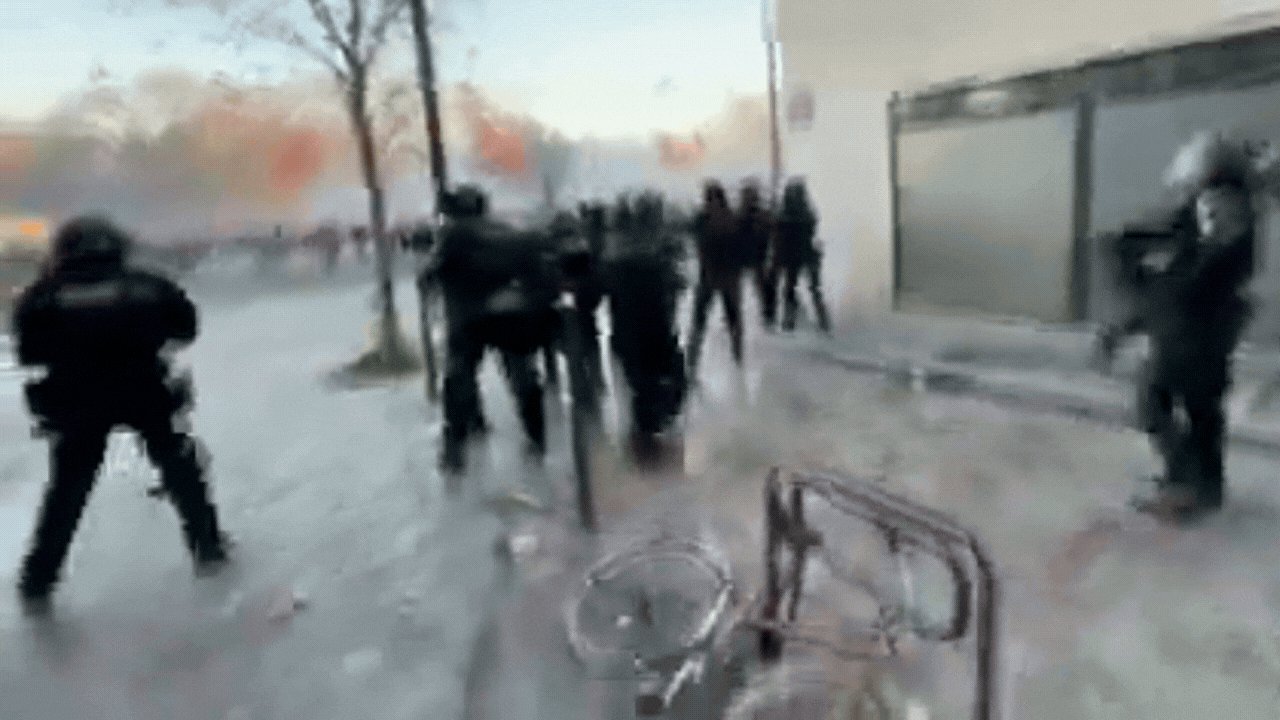
A Molotov cocktail struck a police officer in Paris on Saturday, an act Interior Minister Laurent Nuñez branded “attempted murder” as riots erupted in multiple French cities. The attack occurred during clashes that left five security personnel injured, three of them with burns from incendiary devices. Nuñez condemned the violence as “extraordinary,” noting that while 150 planned demonstrations proceeded peacefully, specific groups escalated the situation dangerously.
The interior ministry reported 565 arrests nationwide, with an estimated 320,000 demonstrators participating—a drop from 410,000 the previous weekend. In Paris, roughly 70,000 people marched from Porte de Bagnolet to Porte de Charenton, bypassing the city center to avoid early confrontations. The peace shattered at the march’s end when dozens of masked individuals in black used hammers to rip up paving stones, hurling them at officers who responded with tear gas and baton charges. The Paris police prefecture stated several hundred rioters launched projectiles at security forces.
Nuñez had deployed 70,000 police officers and gendarmes, including elite units, anticipating a high-risk day. The protests united school students, trade unions, and Yellow Vest activists, driven by anger over living costs and public service decay under President Emmanuel Macron’s administration. In Lyon, police used tear gas after projectiles were thrown, while in Toulouse, water cannons dispersed an unauthorized crowd of several thousand young protesters. The fusion of student and labor grievances created a volatile mix that overwhelmed local security units despite the national deployment.
The unrest extended beyond France’s borders. In Germany, youth-led rallies by the group “Gen Z regelt!” turned violent in cities including Frankfurt, where stores were looted, and Cologne, where police used water cannons against fireworks. Berlin saw bottles and eggs thrown, while Hamburg witnesses reported barricades set ablaze. In Albania’s capital, Tirana, masked youths attacked police with paving stones and firebombs during a march demanding Prime Minister Edi Rama’s resignation. Alerts remained high in Barcelona and Italy following recent clashes in Milan, Turin, and Bologna.
Student organizations announced plans for high school and university blockades on Tuesday and Thursday, setting the stage for a larger confrontation. They intend to join a demonstration called by workers and trade unions on November 5. The next 48 hours will determine whether the coalition of students and unions can maintain momentum or if the heavy-handed security response will fracture the movement.